
Why I Love the Bible so Much
One of the reasons I love the Bible so deeply is because the more I study it, the more layers I uncover beneath the surface.
At first glance, many Bible verses can appear simple. But then archaeology, history, language, geography, and even modern scientific research suddenly illuminate the text in ways that feel astonishingly alive.
Recently I was reflecting on Colossians 3:9,10:
“Strip off the old personality with its practices, and clothe yourselves with the new personality, which through accurate knowledge is being made new according to the image of the One who created it.”
For years I understood this primarily as moral instruction — changing one’s behavior and thinking. But then I came across modern psychological research known as “Enclothed Cognition.”
Researchers used this term to describe how clothing can influence the wearer’s psychological state and behavior. In one experiment, participants wearing a lab coat associated with a doctor showed increased attentiveness and focus compared to those who did not wear it. Fascinatingly, the symbolic meaning attached to the clothing mattered. A “doctor’s coat” influenced the mind differently from the exact same coat described merely as a painter’s coat.
The conclusion was powerful:
Human beings are influenced both by the symbolic meaning of clothing and by the physical experience of wearing it.
Immediately my mind went back to Colossians.
“Clothe yourselves with the new personality.”
Suddenly Paul’s words felt even deeper.
The Bible was not merely speaking about external behavior. It was describing a transformation of identity itself — consciously putting on a new symbolic way of life patterned after God’s image.
And then the historical setting became even more fascinating.
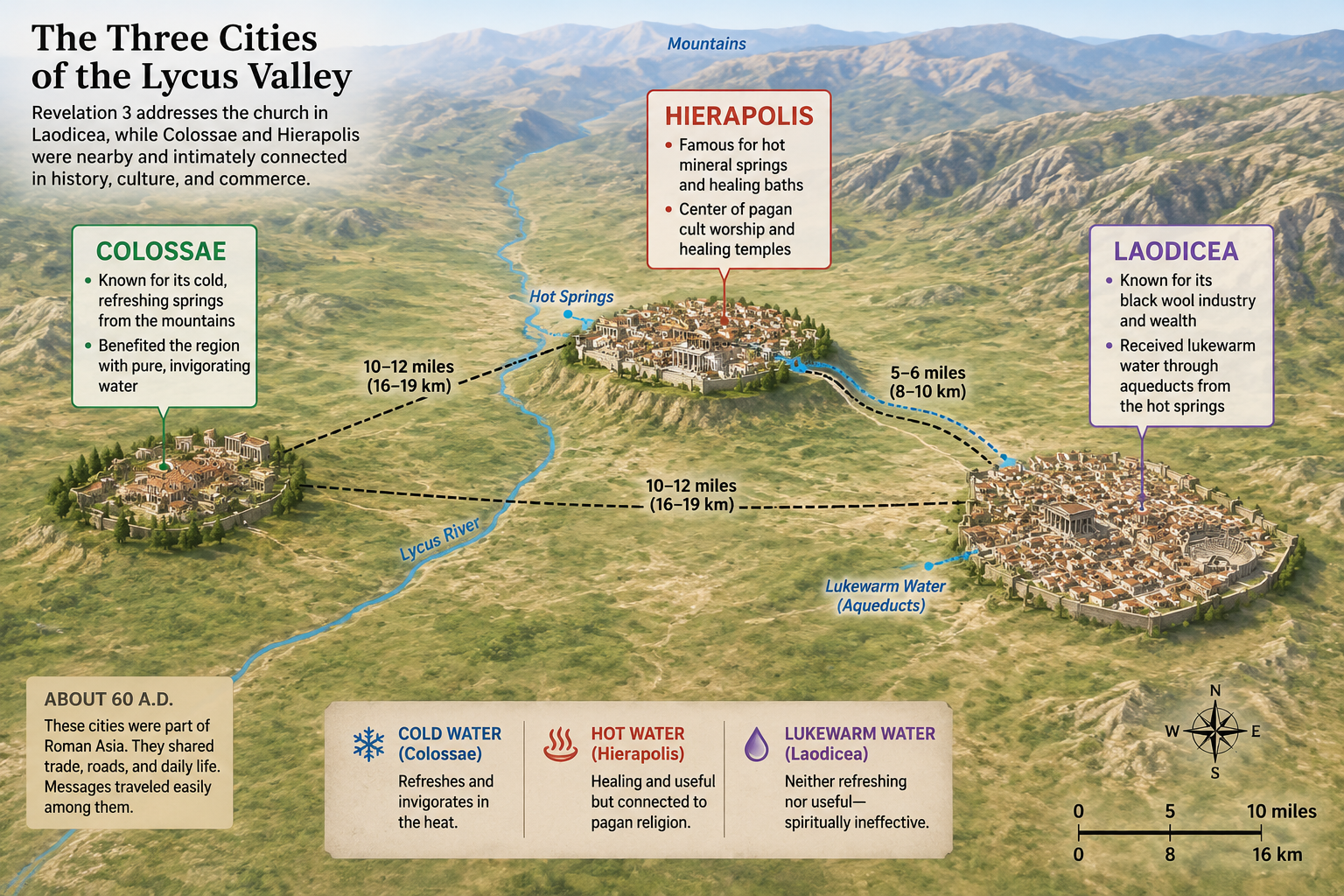
The congregation at Colossae lived near Laodicea and Hierapolis — cities famous for textiles, wool production, and distinctive regional waters.
Archaeologists and historians note that Laodicea was renowned for its luxurious black wool garments. Yet in Revelation 3, Christ counsels the Laodiceans to obtain “white garments” so that the shame of their nakedness would not be exposed.
What a striking contrast.
A city proud of its black wool is spiritually told:
“You think you are clothed in glory, but spiritually you are naked. You need white garments instead.”
This becomes even more meaningful when connected to the Bible’s repeated imagery of sheep and shepherds.
Jesus described himself as the Fine Shepherd caring for his flock. Throughout Scripture, God’s people are repeatedly likened to sheep — a clean, protected, guided flock belonging to Him. White garments and white wool therefore become fitting symbols of purity, loyalty, and belonging to Christ’s flock rather than to the surrounding world.
In that sense, the imagery almost says:
Do not wear the black wool of worldly identity and spiritual compromise.
Wear the white wool of Christ’s flock.
Belong to Him.
Reflect His purity.
Carry His identity.
The symbolism becomes even more vivid when considering the waters of the region.
Colossae was known for refreshing cold springs flowing from the mountains.
Hierapolis was famous for hot mineral springs and healing spas connected to pagan religious culture.
Laodicea received unpleasant lukewarm water through aqueduct systems.
Then Revelation says:
“Because you are lukewarm and neither hot nor cold, I am going to vomit you out of my mouth.”
Many people read this as merely meaning “be enthusiastic.” But the local geography adds remarkable depth.
Cold waters refreshed people in intense heat.
The hot springs of Hierapolis were associated with pagan healing systems and religious mixture.
Lukewarm water was unpleasant, unsatisfying, and ineffective.
Spiritually, the warning becomes profound:
Choose the refreshing waters of truth and full devotion to God rather than mixture, compromise, and spiritual complacency.
Even the “heat” itself becomes meaningful. Throughout Scripture, heat, fire, and refining often symbolize persecution, testing, and pressure. In times of spiritual heat, refreshing cold water becomes life-giving.
What amazes me is how the Bible repeatedly weaves together:
history,
psychology,
geography,
symbolism,
human behavior,
and spiritual truth.
The people hearing these messages originally would have lived inside these symbols daily:
wearing the garments,
seeing the wool,
feeling the heat,
drinking the waters,
walking the trade roads,
and understanding the local culture instinctively.
The Bible speaks in ways that are deeply human yet spiritually profound.
And every time I uncover another layer like this, my appreciation only grows stronger.
The Bible does not become smaller under examination.
It becomes deeper.